
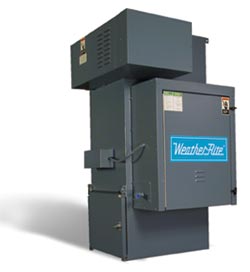
 There are many buildings, especially industrial buildings, that are exhausting fumes, material, noxious gases, etc… from the air, but are not forcing make-up air back into the spaces. This is a common situation, especially in manufacturing operations where fumes or other airborne contaminants are a safety concern. Of course in most cases there is some make-up air entering the building, generally under doors, through cracks, bad window seals, and various other openings. The problem with this situation is that this is typically insufficient air quantity, and it is untreated. The rule of thumb for building balance is that for every cubic foot of air that is removed through forced exhaust, a cubic foot of forced make-up air should replace it. Forced make-up air, fan-fed, is the best way to balance a space that is being exhausted. Granted, some air will infiltrate the space through migration, but it will most likely not be balanced. The result will be higher fuel bills, as the existing heating system will be strained to temper incoming air; higher electrical bills, as the fans have to work harder to exhaust, while working against the increased static pressure of the resulting negative pressure; and accordingly, decreased performance in these same exhaust fans as a result of working against this higher static pressure.
The best solution for negative space conditions is forced make-up air. In some cases this can be accomplished with a supply fan (fans) that matches the amount of air being exhausted. However, in most cases the best approach is to temper the make-up air as well to provide for employee comfort and/or a consistent process environment. In some cases the air will need to be cooled and/or controlled for humidity. This can be accomplished with chilled water or DX refrigeration systems. The most common approach with make-up air is to heat the air in colder months, and supply non-tempered air in warmer months. Make-up air is typically heated with gas, steam, hot water, electrical strip heat, and sometimes heat pump technology. In some cases a mixing box can be used to mix the warmer air that rises in the space with the outside air to temper the air.
Sizing a make-up air unit is often as simple as matching the supply volume to the amount of air being exhausted. In some cases it is advisable to oversize a little to ensure the space is slightly positive. On the other hand, there may be other considerations such as heat loss or other negative pressure influences from adjacent spaces that will require a tight balanced space. Make-up air can be heated via direct-fired burners where the flame is actually in the air stream, or indirect-fired burners which utilize a heat exchanger to keep the flame and products of combustion away from the air stream. The type of burner will vary depending on the space being heated, owner concerns, operating budgets, and/or safety issues and is usually determined on a case-by-case basis.
Make-up air is crucial for healthy happy employees, consistent process environment, and in many cases state and federal regulations. The best way to size and select make-up air systems is to contact a qualified specialist. RJ Owen Associates is a full service representative operating in the industrial heating and ventilation market. We can help with design, installation, commissioning, operation, and maintenance of industrial ventilation systems.